Your Employees Don't Need Another App. They Need a Human.

Jacob Davis • September 28, 2026

Share this article

Open enrollment season is here. Over the next few weeks, your team will receive the reminder emails, the benefits presentations and maybe another app login or two. Then most of them will return to their regular work and quietly forget the details.

Your people aren't the problem, and the research explains why. In a 2026 Castlight survey of about 2,000 U.S. employees, only about one-third said they clearly understand what their benefits offer or use them regularly. Just 7% said open enrollment is what actually prompts them to use their benefits. [1]

So if more information in October isn't the answer, what is? In my experience, it's a person: someone your employees already know, who reaches out before a health problem turns into an expensive claim. Here's why that approach works, and how you can add it without changing your plan or your broker.

Section 1 image:

Why Do Employees Skip the Benefits You Already Pay For?

Short answer: they're confused, not indifferent.

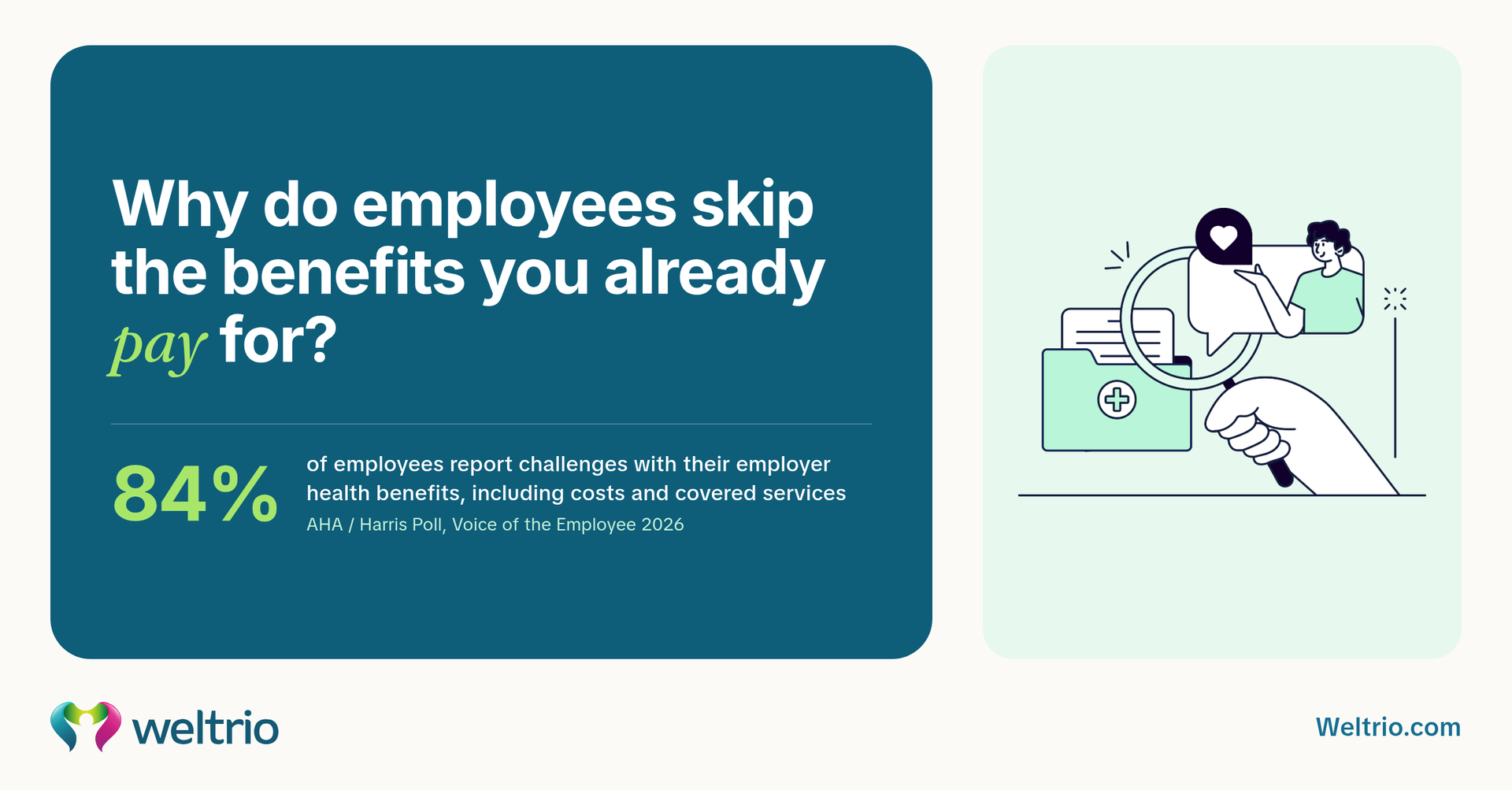
84% of employees at companies with 25 or more workers report challenges with their employer health benefits, including understanding costs and covered services. [2] So when a health need comes up, many employees never check what the plan already provides. Castlight found that 36% immediately look for their own solution, and 46% pay out of pocket for options that feel more relevant or easier to use. [1]

Timing matters, too. The moments that actually prompt people to use their benefits are doctor visits (47%) and urgent or unexpected needs, while enrollment week barely registers. [1] Think about what that means for your budget. The decision that drives your costs usually happens on an ordinary Tuesday evening, when nobody from HR is available to help.

A plan can be carefully designed and still lose money this way. When people don't know where to go, they default to the familiar choice, and that's frequently the most expensive one.

Section 2 image:

Why Can't an App Close the Gap on Its Own?

Apps are useful, and we have one ourselves. But downloads don't equal engagement.

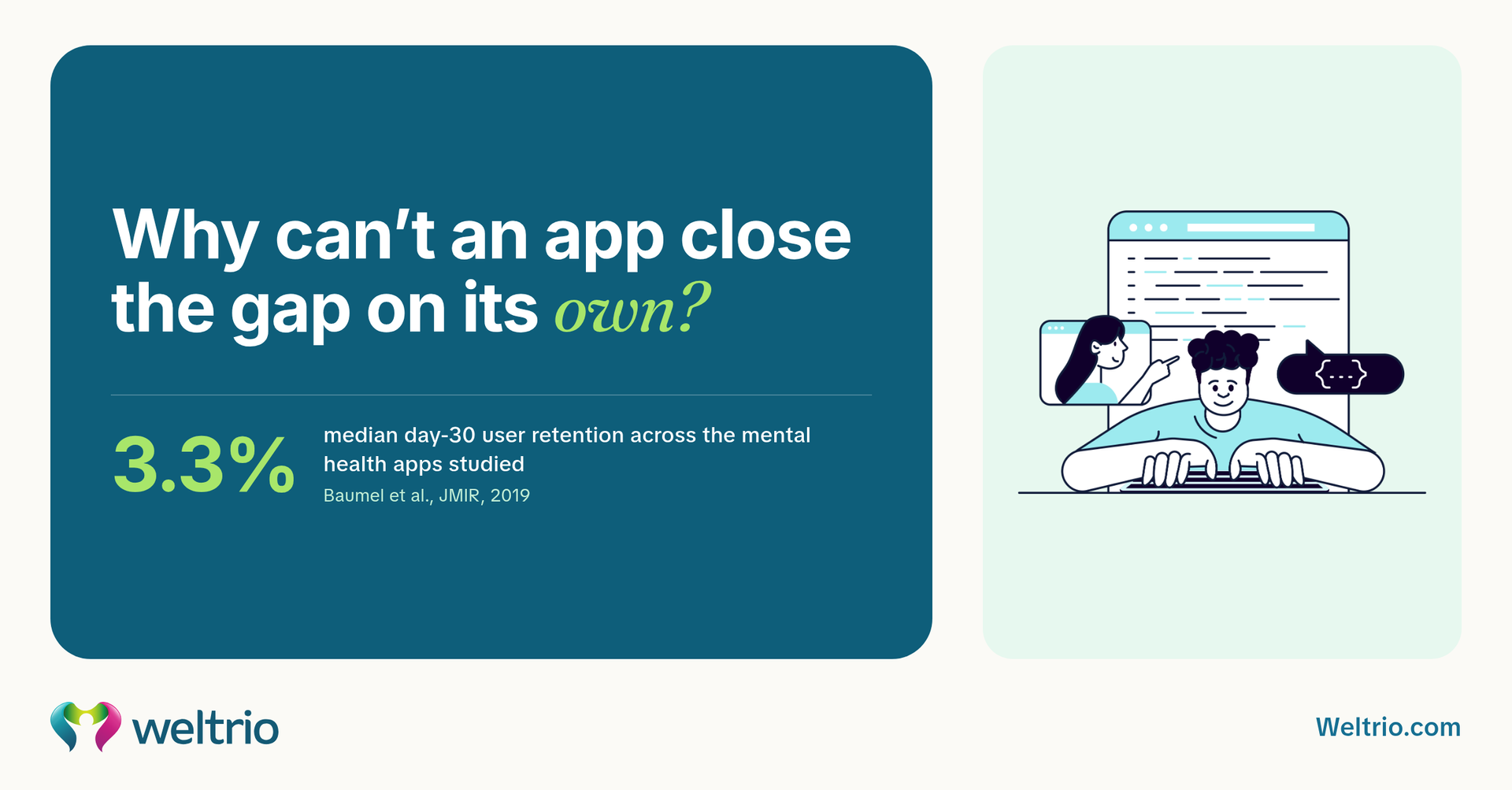
One study of mental health apps found that the median app retained just 3.3% of its users by day 30. [3] That research examined mental health apps specifically. Still, the pattern will sound familiar to anyone who has introduced a new tool and watched the logins gradually disappear.

Employers are noticing. In Business Group on Health's 2027 survey, 58% of employers said they're eliminating vendors that underperform, while they expect healthcare costs to rise a median 9.2% in 2027 (8% after plan design changes). [4]

The technology usually works fine. The difficulty is that an app waits for the employee to show up. When someone is worried, busy or uncertain, they rarely open another portal. They call someone they trust, or they do nothing at all.

That's why the Weltrio app has one focused job: it helps employees and their families connect with their own coach and nurse. The app supports the relationship. It doesn't replace it.

Section 3 image:

What Does a Human Touchpoint Look Like Before a Claim?

Picture this. It's 2 AM, an employee's child has a fever, and the emergency room seems like the only option. Instead of guessing, the parent reaches a nurse who already knows the family. The nurse evaluates the symptoms and recommends the appropriate place for care.

That's the pre-claim moment: the space between plan design and the first claim, where employee decisions either prevent spending or create it.

Here's what that looks like with Weltrio:

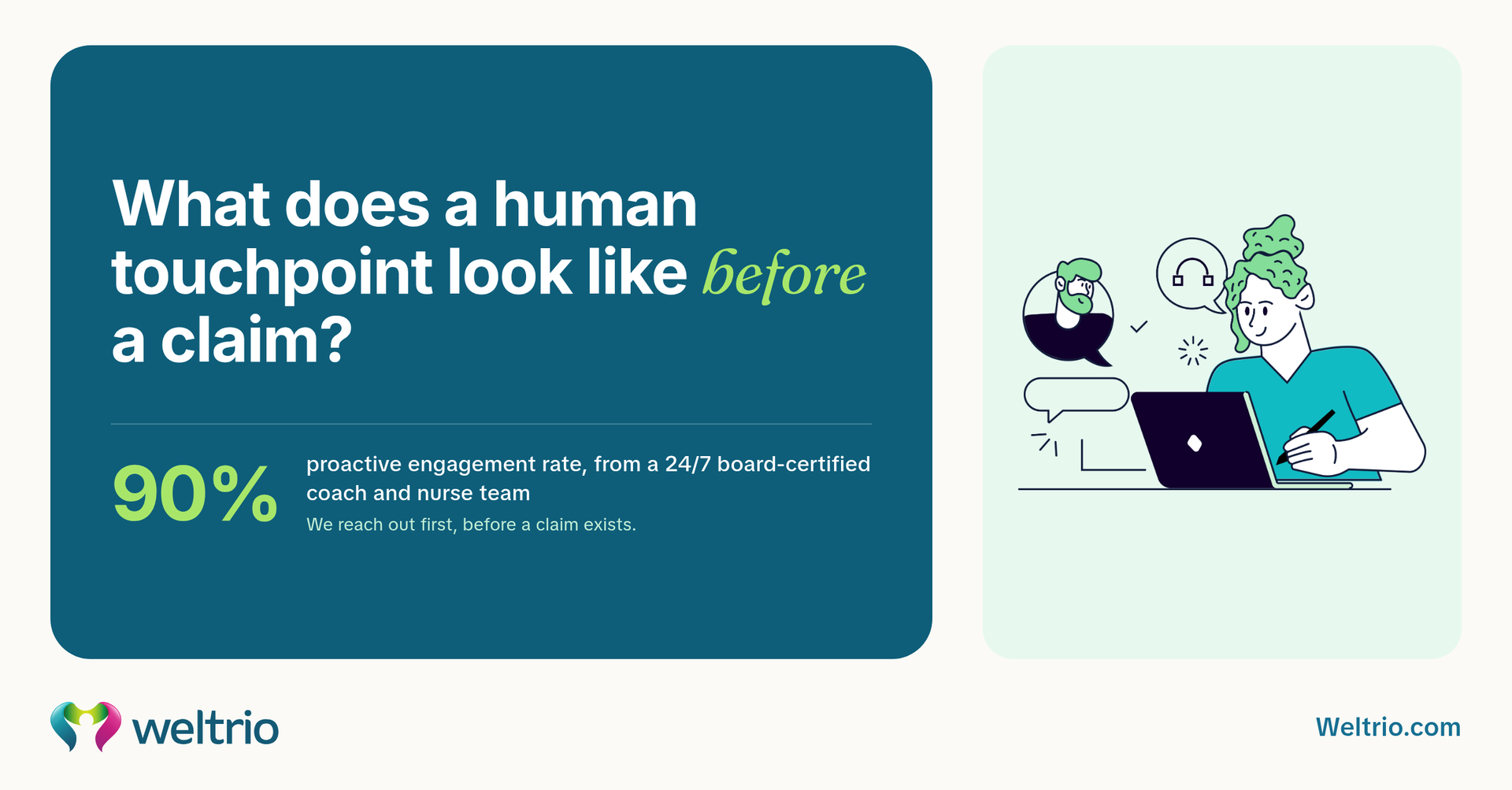
  • A dedicated team for every employee. Each employee receives a 24/7 assigned, board-certified health coach and nurse team.
  • We reach out first. The team contacts employees proactively, before a claim exists, and our proactive engagement rate is 90%.
  • One point of contact. Members get help locating lower-cost, high-quality imaging centers, independent labs and surgery centers before care is booked. That's how we close the Care Navigation gap.

People take action when someone they trust encourages them. In Aflac's 2024 Wellness Matters survey, nearly 7 in 10 adults said they're more likely to visit the doctor if a friend or loved one encourages them. [5] A coach and nurse who genuinely know your employees can fill that role throughout the year.

Section 4 image:

How Do You Add Human Guidance Without Changing Your Plan or Broker?

HR leaders usually ask about this question first, so let's be completely clear.

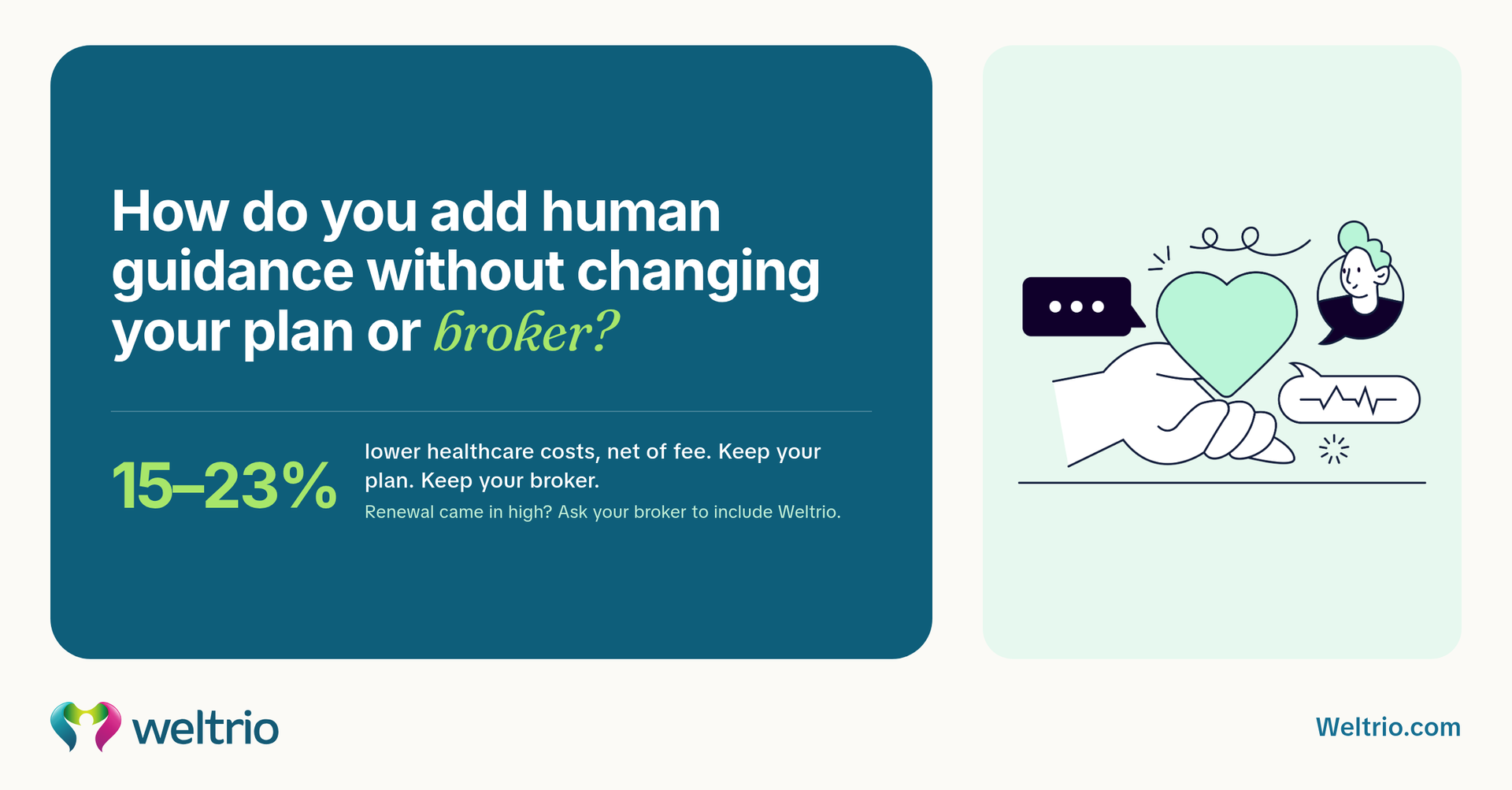
Nothing changes for employees: same plan, same doctors, same benefits. Weltrio works with every insurance carrier and any TPA or PBM arrangement. And you don't need to change brokers. We work alongside yours and help the plan they designed perform the way it should.

The result for employers is 15–23% lower healthcare costs, net of our fee, with no benefit reductions and no limits on where employees receive care. As our client Cayuse Holdings described it: "Weltrio is my single most-profitable cost center."

The timing is favorable, too. For many businesses, renewals arrive in the fall. If your renewal came in high, you don't have to start over. Ask your broker to include Weltrio in the re-quote, so you can see what closing these gaps is worth for your organization.

And for HR leaders, here's the best part: our team does the work, and you receive the credit.

The Bottom Line

Your employees don't need one more login or another benefits portal. They need someone who answers at 2 AM, remembers their name and helps them make a smarter decision before the bill exists. A dollar not spent is 100% of a dollar saved.

Ready to find out where your plan is losing money? Schedule your free assessment or call us at 385-526-7557. Renewal came in high? Ask your broker to include Weltrio in the re-quote. You don't need to change brokers.

Frequently Asked Questions

  • What is care navigation?

    Care navigation gives employees one point of contact who helps them choose the appropriate place for care, such as a lower-cost imaging center or independent lab, before the appointment is booked.

  • Does Weltrio replace our health plan or broker?

    No. Weltrio works alongside your current broker, carrier and TPA or PBM. Employees keep the same plan, the same doctors and the same benefits.

  • Do employees have to use the Weltrio app?

    The app is one convenient way for employees and their families to reach their coach and nurse. The clinical team is the service, and the app simply makes connecting easier for everyone.

  • How much can employers save?

    Employers see 15–23% lower healthcare costs, net of our fee, with no plan changes and no benefit reductions.

  • Our renewal came in high. What should we do?

    Talk with your broker and ask them to include Weltrio in the re-quote before you make any decisions. You don't need to change brokers to add Weltrio.

Sources

  1. Castlight Health, "Employees Spend Up to $1,500 Out of Pocket as Employer Benefits Miss the Mark, Castlight Survey Finds" (2026 Employer Health Benefits Experience Survey, about 2,000 U.S. employees), Apr 28, 2026. https://www.castlighthealth.com/company/news/castlight-releases-2026-employer-health-benefits-experience-survey-results/
  2. American Heart Association CEO Roundtable and The Harris Poll, "Voice of the Employee Survey 2026" (2,001 employees at companies with 25+ employees), May 2026. https://ceoroundtable.heart.org/wp-content/uploads/2026/05/AHA-2026-Voice-of-the-Employee_May-2026.pdf
  3. Baumel A, Muench F, Edan S, Kane JM, "Objective User Engagement With Mental Health Apps: Systematic Search and Panel-Based Usage Analysis," Journal of Medical Internet Research, Sep 2019. https://www.jmir.org/2019/9/e14567/
  4. Business Group on Health, "Cost Volatility Forces Employers To Reassess Healthcare Strategy, Business Group on Health Survey Reveals" (2027 Employer Healthcare Strategy Survey), Aug 25, 2026. https://www.businessgrouphealth.org/newsroom/news-and-press-releases/press-releases/2027-employer-healthcare-strategy-survey
  5. Aflac, "U.S. adults say logistics and 'feeling healthy' among reasons they duck out of routine wellness visits and screenings" (2024 Wellness Matters Survey, 2,000 employed U.S. adults), Aug 5, 2024. https://newsroom.aflac.com/2024-08-05-U-S-adults-say-logistics-and-feeling-healthy-among-reasons-they-duck-out-of-routine-wellness-visits-and-screenings

Recent Posts

By Jacob Davis • August 25, 2026
You don't have a GLP-1 problem. You have a behavior problem. Fix those habits now to get people off the drug, skip carve-outs, and cut year-end renewal hikes.
Behind the Premium roundtable on vetting insurance carriers and benefits vendors
By Kody King • July 23, 2026
A fully funded health plan means renting coverage you cannot see into. Here is why employers should go self-managed to win back the data, transparency, and control.
Rhonda Nerenberg on metabolic health and what normal labs miss, Weltrio
By Rhonda Nerenberg • June 29, 2026
A nurse's take on metabolic health: why "normal" labs miss the real story, why fat is a symptom, and the tests to ask for. From Weltrio's Rhonda Nerenberg.
Jacob Davis on how HR earns a seat at the table, Benefits 3.0
By Jacob Davis • June 28, 2026
Weltrio CEO Jacob Davis on how HR earns a seat at the table by treating the benefits plan as a strategic lever, plus the broker and CFO questions to ask.
Steve Smith, Rhonda Nerenberg, Jacob Davis  in call tiles with text: “REDUCE ABSENTEEISM NOW
By Kody King • June 25, 2026
Weltrio's Kody King on why customized benefit plans could cut absenteeism better than a bigger paycheck, and how pre-claim data makes the business case.
Why More Healthcare Data Won't Lower Your Costs - Benefits 3.0
By Jacob Davis • June 13, 2026
Healthcare has never had more data - so why do costs keep rising? Weltrio's Jacob Davis on why engagement, not analytics or AI, is the real lever.

Weltrio Health Advocates
By Kody King • February 23, 2026
Stop healthcare waste before it becomes a claim. Every employee gets an assigned, board-certified health coach and nurse team, 24/7. The result: 90% proactive engagement.