
Rate Shopping Isn't Cost Containment. Put Containment in the Re-Quote.
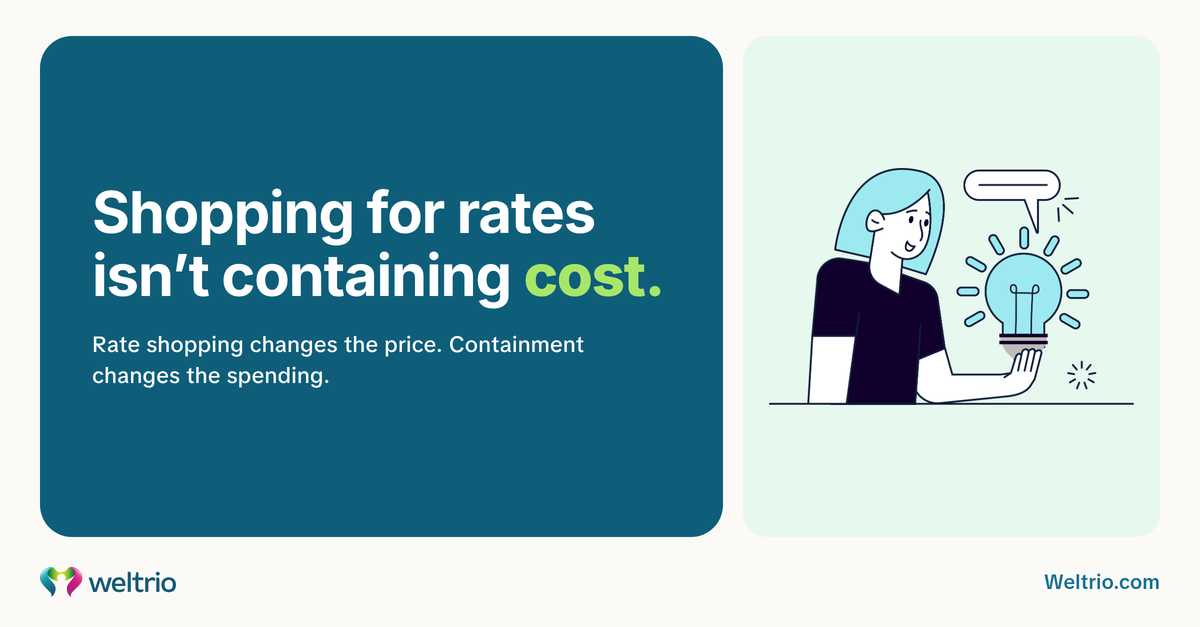
Healthcare cost containment at renewal means lowering what your plan spends on care before a claim exists, rather than simply finding a cheaper rate for the same claims. Rate shopping changes the price. Containment changes the spending. Ask your broker to put a pre-claim containment partner in the re-quote. You don't need to change brokers to do it. That partner is Weltrio, a health advocacy partner for employers.
Your renewal came in high, and the usual next step is to shop carriers, raise deductibles and sign whichever quote hurts the least. That can change the premium line on your budget. It doesn't shrink the claims that pushed the number up in the first place.
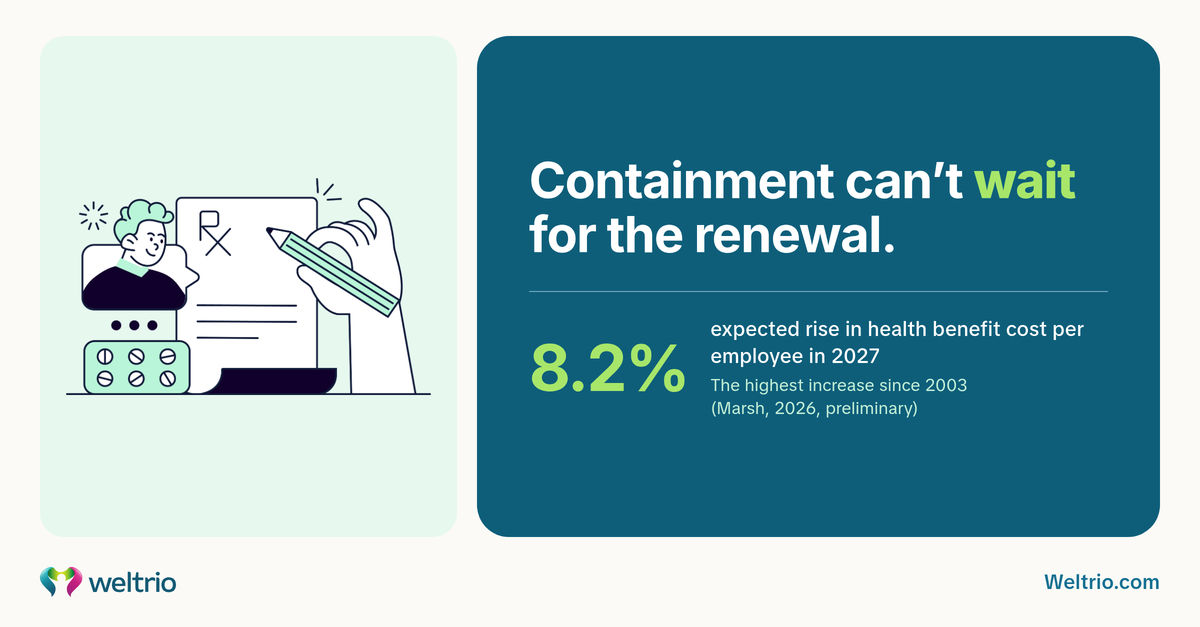
The financial pressure behind this year's renewals is significant. In Marsh's preliminary 2026 survey, total health benefit cost per employee is expected to rise 8.2% on average in 2027, the highest increase since 2003, even after planned cost-reduction measures. Without action, employers expect 11%.
Below, we'll look at why rate shopping falls short, what happens when containment waits for renewal, where containment actually happens, and how to add it to your re-quote.

Why Isn't Rate Shopping the Same as Cost Containment?
Rate shopping changes the price you pay for coverage. Cost containment changes how much care your plan pays for in the first place, which makes them two different jobs with two different results.
The industry is saying the same thing. A recent Insurance Journal article (2026) put it plainly: brokers can no longer rely on rate shopping alone to find the right benefits package at renewal. Many brokers are looking for additional strategies to recommend to their clients.
The national forecasts explain why. Aon's 2026 analysis says U.S. employer health care costs are projected to rise 9.5% in 2027, pushing average costs above $19,000 per employee. That's Aon's status quo projection, before employers make any changes. In PwC's 2026 report, health plan actuaries project a 9% group medical cost trend for 2027, the highest in 17 years.
A different insurance carrier still has to pay for the medical care your employees use. If the claims behind your renewal continue to grow, next year's quote can climb right along with them.
As World Insurance (2026) puts it, the renewal is the result. So the more useful question at renewal is what's actually driving the increase. Rate shopping skips that question entirely. Containment starts with it.

What Happens When Containment Waits Until Renewal?
When containment waits until renewal, the money is already spent. The claims that drove the increase happened months ago. The usual renewal moves mostly decide who pays for them.
Forecasts keep missing, too. The Business Group on Health's 2027 survey found that employers predict a median 9.2% healthcare cost trend increase for 2027, offset to 8% with plan design changes. Actual costs have exceeded employer predictions for three consecutive years.
Then comes the familiar fix. In Marsh's 2026 survey, 59% of employers plan to make changes to health benefits in 2027 to lower cost, including plan design changes like higher deductibles. Those changes can reduce the company's share for one budget cycle, and they can also increase what employees pay out of pocket. We've written before about why cost shifting has run out of room. But the emergency room visit still happens, and the prescription still gets filled.
Now consider where spending actually begins. An employee twists an ankle at 9 PM and drives to the emergency room, because it's the only place they know is open. Another fills a new prescription without asking about a lower-cost option. A third puts off a recommended screening. Each of those choices happens before a claim exists.
That's why we say, "A dollar not spent is 100% of a dollar saved." A shifted dollar still gets spent, and somebody at your company still pays it.

Where Does Real Cost Containment Happen?
Real cost containment happens before the claim, during the moments when employees decide where and how to receive care. To understand why, it helps to look at how an employer health plan is organized.
Every employer health plan depends on three pillars, in this order:
- Plan Optimization. Your broker owns this pillar, which covers plan design and changes only at renewal.
- Care Logistics. TPAs and PBMs own this pillar, which is reactive and operates after the claim.
- Health Advocates. This is Weltrio. It's proactive and owns the pre-claim gap, the space between plan design and the first claim.
Pillars 1 + 2 without Pillar 3 = Gaps = Waste + Cost + Risk.
Rate shopping and plan design changes belong to Pillar 1. Claims processing and pharmacy pricing belong to Pillar 2. Both are important, but neither is designed to guide an individual employee before they schedule appointments or treatment.
That's where the gaps appear. We focus on five of them:
- ER Visits
- RX Overpayment
- Care Navigation
- Late Diagnosis
- Care Logistics
One clarification, so the two lists don't blur together: the Care Logistics gap is separate from the Care Logistics pillar above. The pillar belongs to TPAs and PBMs. The gap is one of the five areas where we identify avoidable spending.
Here's how Weltrio closes those gaps. Every employee gets a 24/7 assigned, board-certified health coach and nurse team. We don't wait for employees to contact us. We reach out first, and that's how Weltrio maintains a 90% proactive engagement rate.

How Do You Put Containment in the Re-Quote Without Changing Brokers?
Ask your broker to include Weltrio in the re-quote. You don't need to change brokers. A re-quote (or request for quote, RFQ) is when your broker goes back to your carrier or the market for new pricing and options before you sign the renewal. Your broker already understands your plan design, your claims history and your renewal pricing, which makes them the right professional to introduce containment into the conversation.
What Should You Ask Your Broker Before You Sign?
Bring these four questions to your next renewal discussion:
- What's driving our claims?
- What does our plan do before a claim?
- Can we include Weltrio in the RFQ or re-quote?
- What's the return, net of fee?
If you're a broker, this gives you something valuable and different to bring to a difficult renewal conversation. We work alongside you, never against you. You remain the trusted advisor, and your client gains a clinical containment partner for the decisions that happen before a claim.
Here's what participating employers see: 15–23% lower costs, net of fee. Nothing changes for employees: same plan, same doctors, same benefits. There are no plan changes and no benefit cuts, and your broker continues managing the plan.
A high renewal is the right opportunity to examine what's driving your healthcare costs. Ask your broker to include Weltrio in the re-quote, and then let us identify where your plan's pre-claim gaps are.
Prefer a personal conversation first? Call our team directly at 385-526-7557.
Is shopping carriers cost containment?
No. Shopping carriers can change your premium rate, but it doesn't change the individual care decisions that drive your claims. Cost containment reduces spending before a claim exists, and that's where Weltrio operates.
Can we add Weltrio without changing brokers?
Yes. You don't need to change brokers. Ask your broker to include Weltrio in the re-quote, and we'll work alongside them as a partner through the renewal and the entire plan year.
Does Weltrio change our plan or benefits?
No. Nothing changes for employees: same plan, same doctors, same benefits. Every employee gets a 24/7 assigned, board-certified health coach and nurse team.
How does Weltrio show results?
Weltrio's results are stated net of fee: employers see 15–23% lower costs, net of fee. Your free assessment identifies where your plan's pre-claim gaps are and what they're costing you.
Sources
- Riva Dumeny, "Amid Soaring Costs, Health Benefits Brokers Seek New Strategies," Insurance Journal, October 5, 2026. https://www.insurancejournal.com/magazines/mag-features/2026/10/05/887590.htm
- Mercer (a Marsh business), "Employers expect health benefit costs to jump 8.2% in 2027, and the impact will likely be felt by workers, according to Marsh" (preliminary 2026 National Survey of Employer-Sponsored Health Plans), September 2, 2026. https://www.mercer.com/en-us/about/newsroom/employers-expect-health-benefit-costs-to-jump-in-2027/
- Michael Bass, "Looking Beyond the Renewal: A Smarter Approach to Managing Healthcare Costs," World Insurance, July 31, 2026. https://www.worldinsurance.com/eb/articles/looking-beyond-the-renewal-healthcare-cost-management
- Business Group on Health, "Cost Volatility Forces Employers To Reassess Healthcare Strategy, Business Group on Health Survey Reveals" (2027 Employer Healthcare Strategy Survey), August 25, 2026. https://www.businessgrouphealth.org/newsroom/news-and-press-releases/press-releases/2027-employer-healthcare-strategy-survey
- Aon, "Aon: U.S. Employer Health Care Costs Continue Multi-Year Climb, Projected to Rise 9.5% in 2027," August 20, 2026. https://aon.mediaroom.com/2026-08-20-Aon-U-S-Employer-Health-Care-Costs-Continue-Multi-Year-Climb,-Projected-to-Rise-9-5-in-2027
- PwC Health Research Institute, "Medical cost trend is expected to hit 9%, highest in 17 years. Can cost management strategies bend the trend?" (Behind the Numbers 2027), June 11, 2026. https://www.pwc.com/us/en/industries/health-industries/library/behind-the-numbers.html
About the Author
Jacob Davis is Weltrio's Chief Executive Officer. He took on the role in January 2026 after serving as Weltrio's Chief Operating Officer starting in March 2025. Jacob describes himself as someone who builds systems that solve problems, and his main focus is helping employers. He studied at Western Governors University and holds a Six Sigma certification.