

Before You Sign That High-Rate 2027 Insurance Renewal, Request A Re-Quote.

Rhonda Nerenberg • October 5, 2026

Share this article

If your 2027 health insurance renewal came in high, don't automatically raise the deductible. Cancer is employers' top healthcare cost driver, and in 2010 claims data, stage IV breast cancer cost nearly twice as much to treat over two years as stage I/II disease. Before you sign, ask your benefits broker to add Weltrio to the re-quote, because our coach and nurse team closes the Late Diagnosis gap before a claim. You don't need to change brokers.

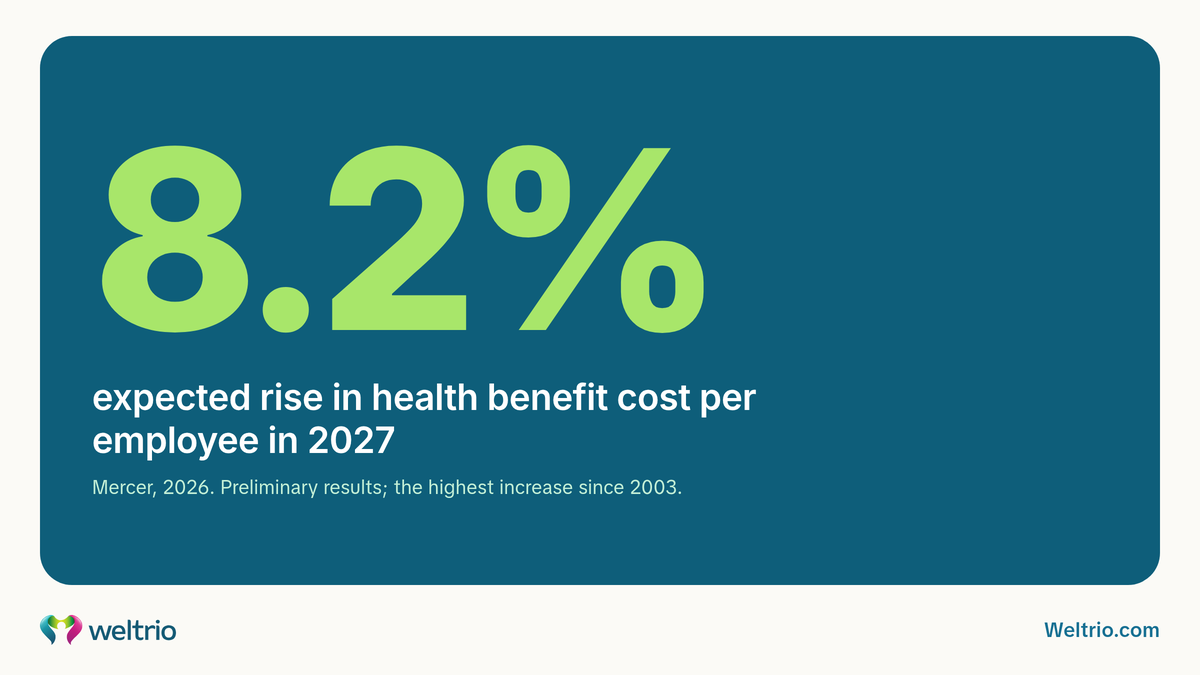
Employers expect the highest increase in health benefit cost per employee since 2003. [1] The usual renewal fixes don't touch the condition at the top of the bill. Below, I'll cover why employer health insurance renewals are so high, what cancer adds, how earlier detection lowers claims, and how your broker can bring us in.

In this article:

Why Are 2027 Health Renewals Coming In So High?

Employers expect total health benefit cost per employee to rise 8.2% on average in 2027, the highest increase since 2003, even after planned cost-reduction measures. [1] Small-group insurers also proposed a median 14% premium increase for 2027, based on filings from 295 insurers in all 50 states and DC. [4]

Both numbers need a little context. Mercer's figure comes from preliminary results, and without action, employers expect 11%. KFF's 14% is a proposed figure for small-group plans, and the median isn't weighted by enrollment.

Other surveys this season point the same way:

  • Business Group on Health: Employers predict a median 9.2% healthcare cost trend increase for 2027, offset to 8% with plan design changes. [2]
  • Aon: U.S. employer health care costs are projected to rise 9.5% in 2027, pushing average costs above $19,000 per employee. That's the forecast before employers make any changes. [3]

So what do most employers do? They reach for plan design. Mercer found that 59% of employers plan to make cost-cutting changes to health benefits in 2027, including plan design changes like higher deductibles. [1]

That's a real tool, and it belongs to your benefits broker. Plan design only changes at renewal, which is why this moment matters. But a higher deductible moves the cost onto your employees, and it doesn't change what's driving the cost. (Here's why raising the deductible keeps failing at renewal.)

Why Is Cancer the Top Driver of Employer Health Costs?

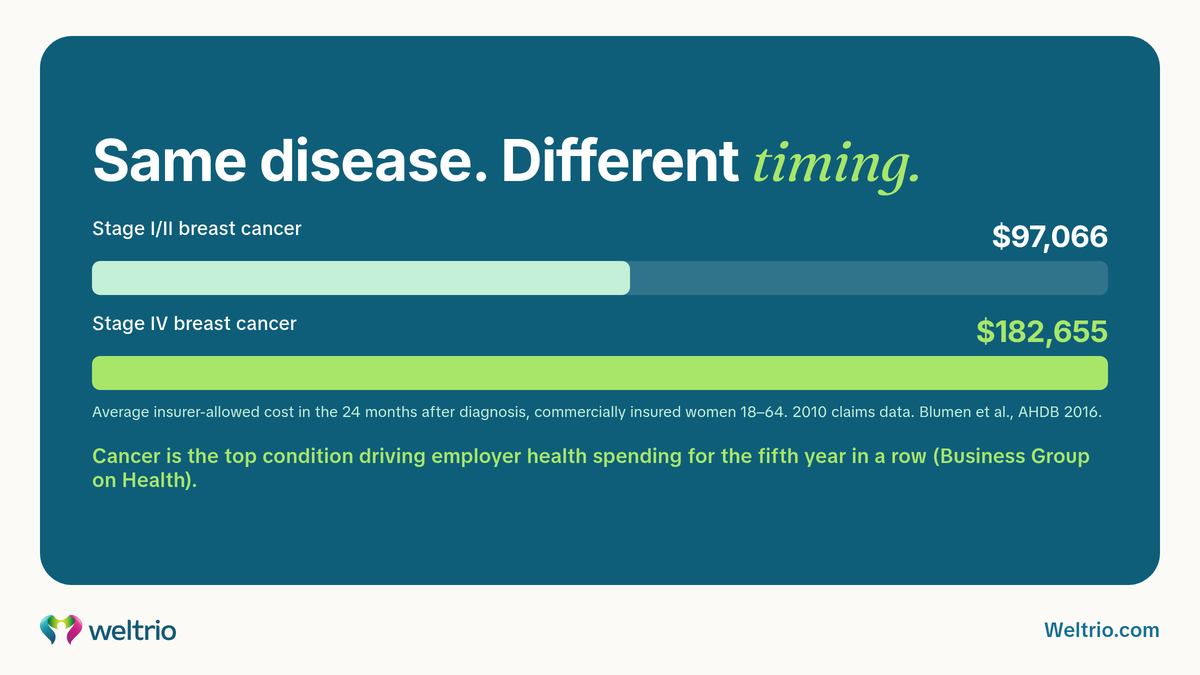
For the fifth year in a row, cancer is the top condition driving employer health spending, according to Business Group on Health's 2027 Employer Healthcare Strategy Survey. In that survey, 70% of employers surveyed said it was their No. 1 cost driver in 2026, up from 58% in 2025. And 92% of employers categorized cancer as one of the top three conditions fueling costs. [2]

I can't tell you cancer alone caused your renewal, because every plan and every workforce is different. But it's the condition most employers now see at the top of the list, so it deserves a place in your re-quote conversation.

Here's the part a CFO should circle: the stage at diagnosis drives the total bill. One published study examined the medical costs of commercially insured women ages 18 to 64 who were diagnosed with breast cancer. Average insurer-allowed costs in the 24 months after diagnosis were $97,066 for stage I/II and $182,655 for stage IV. [5] That's nearly twice as much, and on a smaller plan, a single late-stage claim like that can weigh heavily on the following renewal.

That study used 2010 claims data and was published in 2016, so treat the dollar amounts as a historical snapshot. The difference between early-stage and late-stage breast cancer cost is the point.

At Weltrio, we put it this way: a dollar not spent is 100% of a dollar saved, and one way to avoid a late-stage bill is to identify the problem earlier.

"By the time a claim shows up, the money is already spent and nobody can explain what bought what. We work upstream of that."

Rhonda Nerenberg, Founder & Chief Health Innovation Officer, Weltrio

How Does Closing the Late Diagnosis Gap Lower Future Claims?

Closing the Late Diagnosis gap lowers future claims because screenings and follow-up care get done sooner. That helps prevent a late cancer diagnosis and the big claim that can follow.

Late Diagnosis is one of the gaps closed by Health Advocates, the proactive pillar that works before a claim. Here's how we define it:

Late Diagnosis: proactive outreach drives preventive completion, and Weltrio coordinates rising-risk members' care early, keeping manageable conditions from becoming catastrophic claims.

In plain terms, we help people get checked sooner, while problems are easier to treat.

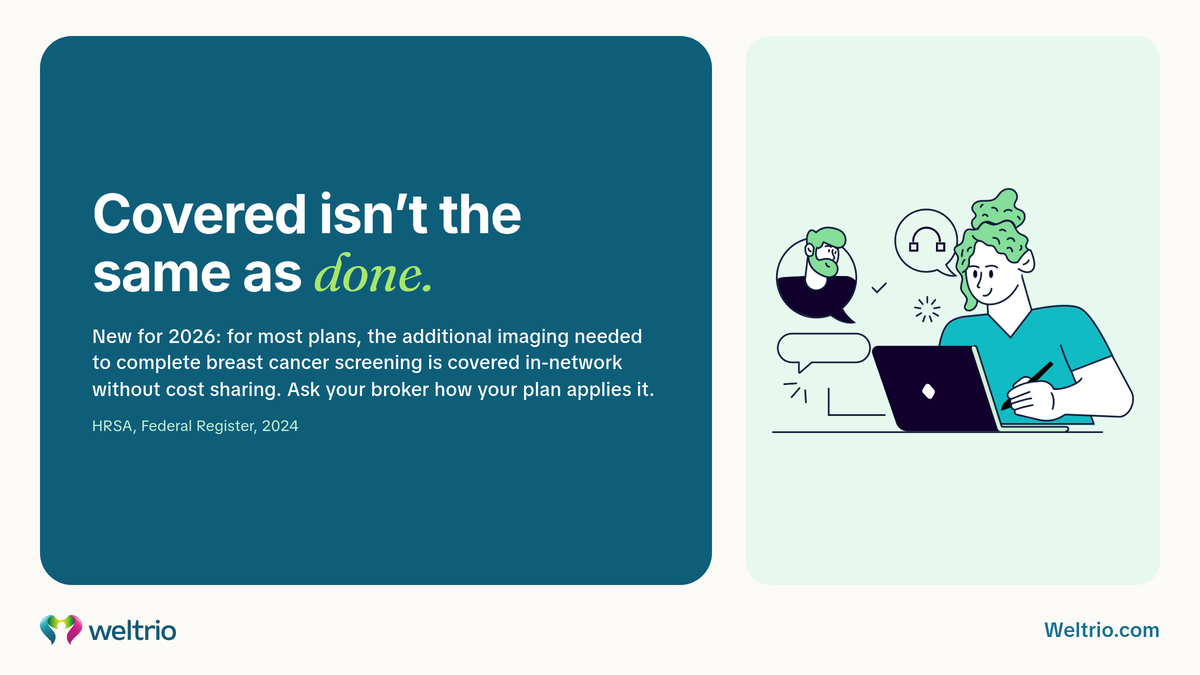
For most plans, starting with 2026 plan years, the additional imaging (such as MRI, ultrasound or more mammography) and pathology needed to complete breast cancer screening are covered in-network without cost sharing. Those plans must also cover person-to-person patient navigation for breast and cervical cancer screening. [6] Ask your broker how your plan applies it. That's timely, since October is Breast Cancer Awareness Month.

That's good news. But covered isn't the same as done.

People put off care, even when it's covered. In Aflac's 2024 survey, 77% of employed U.S. adults admitted to putting off a health checkup beyond the recommended timeframe at least occasionally. [7]

So what helps? A person. In a meta-analysis of 33 randomized trials cited by HRSA, breast cancer screening rates were 14.1% higher for patients randomized to patient navigation services. [6]

That's the work our team does every day:

  • Every employee gets a team. We provide a 24/7 assigned, board-certified health coach and nurse team for every employee.
  • We reach out first. We don't wait for the phone to ring. Our proactive employee engagement rate is 90%. (See how a 24/7 coach and nurse team reaches employees first.)
  • The app keeps them close. The Weltrio app helps employees and family members connect with their coach and nurse. It supports the human touchpoint, and it doesn't replace it.

When the reminder comes from a nurse who knows you, the screening is easier to book. So is the follow-up imaging.

How Can Your Broker Add Weltrio to This Year's Re-Quote?

Ask your benefits broker to include Weltrio in the re-quote before you sign. A re-quote (or request for quote, RFQ) is when your broker goes back to your carrier or the market for new pricing and options before you sign the renewal. You don't need to change brokers.

You won't be the only employer pushing on price: Business Group on Health found that 71% of employers are using the RFP (request for proposal) process to secure lower pricing. [2] A health insurance re-quote is the right time to ask what else belongs on the table. Your broker already manages the carriers, the pricing and the plan design. Adding Weltrio to the request gives them one more option to compare, one that addresses employee decisions instead of benefit levels.

Here are the three pillars that shape your costs, in order:

  1. Plan Optimization. Your broker owns this, and it only changes at renewal.
  2. Care Logistics. Your TPA (third-party administrator) or PBM (pharmacy benefit manager) owns this. It's reactive and works after claims.
  3. Health Advocates. That's Weltrio. We're proactive, and we own the pre-claim gap: the space between plan design and the first claim, where employee decisions either prevent spending or create it.

The first two pillars matter, but without the third, gaps stay open, and those gaps mean waste, cost and risk for your plan.

Nothing changes for employees: same plan, same doctors, same benefits. We work with every carrier and any TPA or PBM arrangement. Your broker stays in the lead, and we work in their blind spot, never against them. We also help your broker look good at renewal. Because we operate before the claim, we bring pre-claim data that post-claim vendors can't, which feeds smarter plan design at the next renewal.

The result: employers see 15–23% lower healthcare costs, net of our fee, with no plan changes and no benefit cuts. Miami Paper, a company with 118 employees, saved $20K in year one against a 40% renewal threat.

So before you sign, make one phone call: ask your broker to include Weltrio in the re-quote. Or start with a free health plan cost assessment and find out what closing the Late Diagnosis gap is worth to your organization.

Renewal came in high? Put Late Diagnosis on the re-quote before you sign.

Schedule your free assessment or call us at 385-526-7557. We'll show you where your plan is losing money before a claim, and your broker stays in the lead. You don't need to change brokers.

Frequently Asked Questions

  • When do employers usually get their health insurance renewal?

    For plans that start January 1, renewal offers often come in the fall. Start early, and ask your benefits broker for your renewal date and re-quote deadline.

  • What is a re-quote or RFQ in employer health insurance?

    A re-quote (or request for quote, RFQ) is when your broker goes back to your carrier or the market for new pricing and options before you sign the renewal. Business Group on Health found that 71% of employers use the RFP process to secure lower pricing.

  • Can we bring in Weltrio without changing brokers?

    Yes. You don't need to change brokers. Weltrio works alongside your benefits broker and makes the plan they designed work harder.

  • Does adding Weltrio change our plan, network, or benefits?

    No. Nothing changes for employees: same plan, same doctors, same benefits. Weltrio works with every carrier and any TPA or PBM setup. Employers see 15–23% lower costs, net of fee.

  • What is the Late Diagnosis gap?

    Proactive outreach drives preventive completion, and Weltrio coordinates rising-risk members' care early, keeping manageable conditions from becoming catastrophic claims. It's one of the five healthcare gaps Weltrio closes.

  • Is follow-up breast imaging covered with no cost sharing in 2026?

    For most plans, starting with 2026 plan years, the additional imaging (such as MRI, ultrasound or more mammography) and pathology needed to complete breast cancer screening are covered in-network without cost sharing (HRSA, 2024). Ask your broker how your plan applies it.

About the author

Rhonda Nerenberg, RN, BSN, MS , is the Founder and Chief Health Innovation Officer of Weltrio, where she leads the clinical strategy behind the company's pre-claim approach to employer healthcare costs. A registered nurse with a master's in nutrition, she co-hosts Second Opinion on the Behind the Premium podcast network.

Sources

  1. Mercer (a Marsh business), "Employers expect health benefit costs to jump 8.2% in 2027, and the impact will likely be felt by workers, according to Marsh" (preliminary 2026 National Survey of Employer-Sponsored Health Plans), Sep 2, 2026. https://www.mercer.com/en-us/about/newsroom/employers-expect-health-benefit-costs-to-jump-in-2027/
  2. Business Group on Health, "Cost Volatility Forces Employers To Reassess Healthcare Strategy, Business Group on Health Survey Reveals" (2027 Employer Healthcare Strategy Survey), Aug 25, 2026. https://www.businessgrouphealth.org/newsroom/news-and-press-releases/press-releases/2027-employer-healthcare-strategy-survey
  3. Aon, "Aon: U.S. Employer Health Care Costs Continue Multi-Year Climb, Projected to Rise 9.5% in 2027," Aug 20, 2026. (Named source, not linked.)
  4. Peterson-KFF Health System Tracker, "How much and why premiums are going up for small businesses in 2027," Aug 6, 2026. https://www.healthsystemtracker.org/brief/how-much-and-why-premiums-are-going-up-for-small-businesses-in-2027/
  5. Blumen H, Fitch K, Polkus V, "Comparison of Treatment Costs for Breast Cancer, by Tumor Stage and Type of Service," American Health & Drug Benefits 2016;9(1):23–32 (2010 commercial claims data). https://pubmed.ncbi.nlm.nih.gov/27066193/
  6. Health Resources and Services Administration, "Update to the Health Resources and Services Administration-Supported Women's Preventive Services Guidelines," Federal Register, Dec 30, 2024. https://www.federalregister.gov/documents/2024/12/30/2024-31228/update-to-the-health-resources-and-services-administration-supported-womens-preventive-services
  7. Aflac, "U.S. adults say logistics and 'feeling healthy' among reasons they duck out of routine wellness visits and screenings" (2024 Aflac Wellness Matters Survey, 2,000 employed U.S. adults), Aug 5, 2024. https://newsroom.aflac.com/2024-08-05-U-S-adults-say-logistics-and-feeling-healthy-among-reasons-they-duck-out-of-routine-wellness-visits-and-screenings

Recent Posts

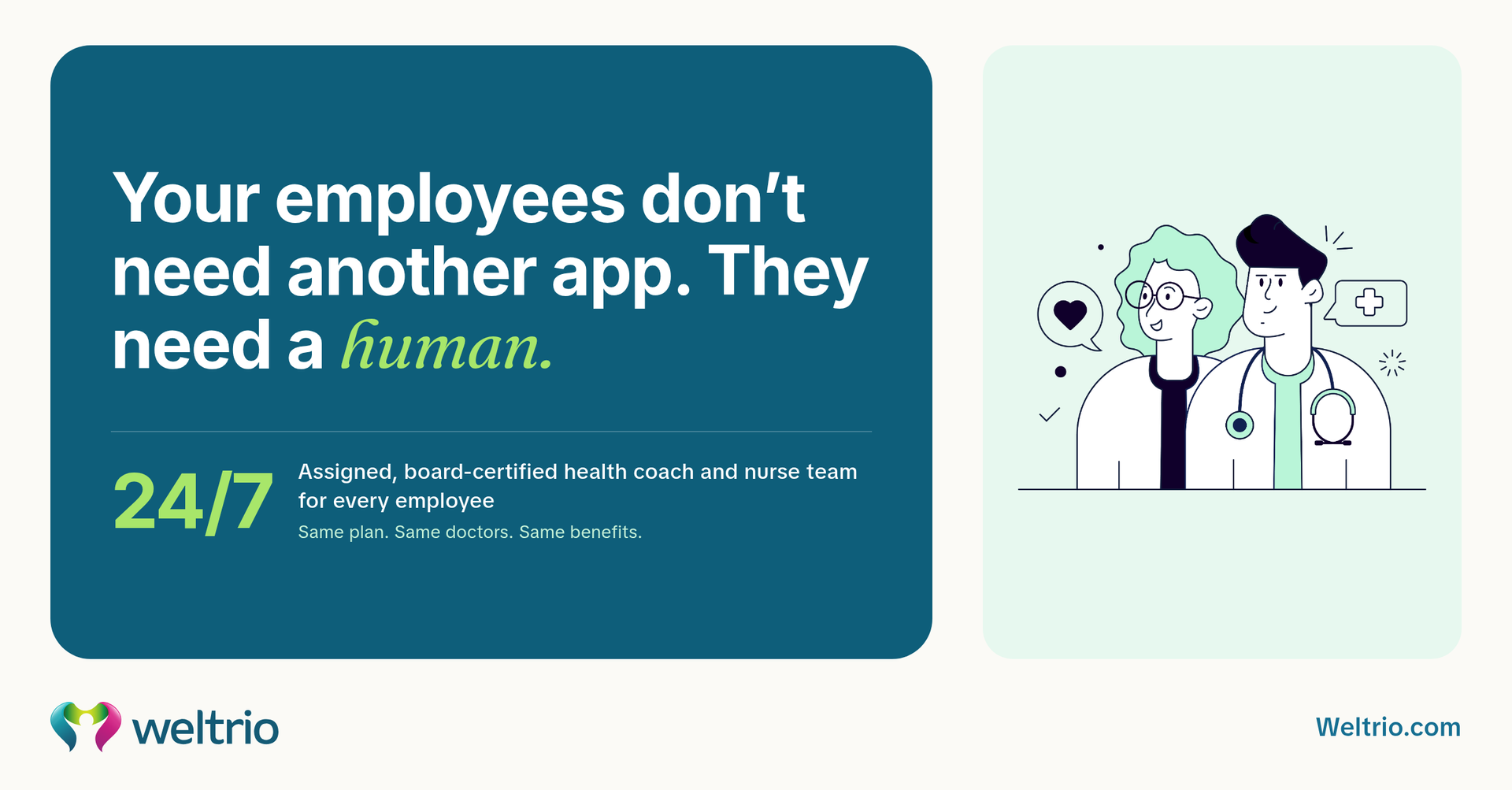
Your employees need a human, not another app. Weltrio coach and nurse illustration beside a teal panel.
By Jacob Davis • September 28, 2026
Most employees don't understand their benefits, and apps alone don't fix it. See how a 24/7 coach and nurse team closes the gap before a claim.

By Jacob Davis • August 25, 2026
You don't have a GLP-1 problem. You have a behavior problem. Fix those habits now to get people off the drug, skip carve-outs, and cut year-end renewal hikes.

Behind the Premium roundtable on vetting insurance carriers and benefits vendors
By Kody King • July 23, 2026
Renting a health plan means paying for coverage you cannot see into. Here is why employers should manage the plan to win back the data, transparency, and control.
Rhonda Nerenberg on metabolic health and what normal labs miss, Weltrio
By Rhonda Nerenberg • June 29, 2026
A nurse's take on metabolic health: why "normal" labs miss the real story, why fat is a symptom, and the tests to ask for. From Weltrio's Rhonda Nerenberg.
Jacob Davis on how HR earns a seat at the table, Benefits 3.0
By Jacob Davis • June 28, 2026
Weltrio CEO Jacob Davis on how HR earns a seat at the table by treating the benefits plan as a strategic lever, plus the broker and CFO questions to ask.
Steve Smith, Rhonda Nerenberg, Jacob Davis  in call tiles with text: “REDUCE ABSENTEEISM NOW
By Kody King • June 25, 2026
Weltrio's Kody King on why customized benefit plans could cut absenteeism better than a bigger paycheck, and how pre-claim data makes the business case.
Why More Healthcare Data Won't Lower Your Costs - Benefits 3.0
By Jacob Davis • June 13, 2026
Healthcare has never had more data - so why do costs keep rising? Weltrio's Jacob Davis on why engagement, not analytics or AI, is the real lever.

Weltrio Health Advocates
By Kody King • February 23, 2026
Stop healthcare waste before it becomes a claim. Every employee gets an assigned, board-certified health coach and nurse team, 24/7. The result: 90% proactive engagement.