
Your Renewal Is a Budget Decision. Read It Like a CFO.
Your health insurance renewal came in high, and someone is expecting a signature soon. Before you sign it, read it the way a CFO reads any other significant line in the operating budget.
Here's the short, practical answer. Before you sign a high renewal, ask three things: what's driving the claims, what the plan does before a claim happens, and what the return is net of fee. You don't need to change brokers to ask them.
Finance leaders are already watching this line closely. In Mercer's 2026 survey, a third of CFOs (33%) now rank health benefit cost as a "Top 3" concern compared to other operating expenses, up from 19% in 2024. When a cost reaches that level of executive attention, it stops being a routine renewal exercise and becomes a strategic financial decision.
Below, we'll look at why the health plan landed on the CFO's desk, why health budgets keep missing their forecasts, why shifting costs to employees doesn't fix the problem, and which questions to bring to your broker before you sign.
Why Is the Health Plan Now on the CFO's Desk?
The health plan is on the CFO's desk because it now competes directly with every other major expense, and many companies are finding the increases hard to absorb.
Mercer found that about three-fourths of CFOs rank health benefit cost at least a top-five concern. And the pressure isn't limited to large corporations. Among employers with fewer than 500 employees, 44% say it is a top-three concern.
Here's the part that reaches the rest of the business. In the same survey, only about one in four CFOs said their organization was able to absorb the cost increases over the past two years without business impacts. Everyone else felt the pressure somewhere, and CFOs reported these impacts:
- Reduced spending on other benefits (38%)
- Slower wage growth (36%)
- Higher prices for products and services (26%)
- Reduced hiring or layoffs (22%)
So the renewal now reaches well past HR. It can affect compensation, hiring plans and the prices you charge your customers. That's why it deserves the same disciplined questions as any other major purchase the company makes.
Why Do Health Budgets Keep Missing the Forecast?
Health budgets keep missing because forecasts are built on historical claims, and actual costs keep running ahead of those projections.
The Business Group on Health's 2027 survey puts numbers on the problem. Employers predict a median 9.2% healthcare cost trend increase for 2027, offset to 8% with plan design changes. Actual costs have exceeded employer predictions for three consecutive years, with each miss greater than the one before, prompting more CFO and senior leader involvement.
Think about what a forecast can actually see. It sees last year's claims, the current plan design and the renewal offer from the carrier. It can't see the individual decisions your employees will make next month.
One employee goes to the emergency room for something a nurse could have handled over the phone. Another fills an expensive prescription when a lower-cost alternative was available. A third postpones a recommended screening. Each of those decisions happens before a claim exists, and by the time it appears in your data, the money is already spent.
So the forecast keeps chasing a number it has no way to control. A more detailed spreadsheet won't close that gap. Changing what happens before the claim can.
Why Doesn't Shifting Costs to Employees Fix the Math?
Shifting costs to employees moves the bill, but it doesn't remove the claim behind it. The care still happens and still gets paid for. For a finance team, that's an accounting transfer between the company and its employees.
Higher deductibles and larger paycheck contributions are the familiar renewal moves. They can lower the company's share for one budget cycle. But the emergency room visit still happens, and the prescription still gets filled. An employee who now owes more may also delay care until the problem becomes more expensive to treat.
That's why we say a dollar not spent is 100% of a dollar saved. A dependable way to improve the math is to prevent unnecessary spending before it starts, while employees are still deciding where to get care.
Every employer health plan depends on three pillars, in this order:
- Plan Optimization. Your broker owns this pillar, which covers plan design, and it changes only at renewal.
- Care Logistics. TPAs and PBMs own this pillar, which is reactive and operates after the claim.
- Health Advocates. This is Weltrio. It's proactive and owns the pre-claim gap, the space between plan design and the first claim.
Pillars 1 + 2 without Pillar 3 = Gaps = Waste + Cost + Risk.
Those gaps are where spending quietly escapes the budget. We focus on five of them:
- ER Visits
- RX Overpayment
- Care Navigation
- Late Diagnosis
- Care Logistics
The Care Logistics gap is separate from the Care Logistics pillar above.
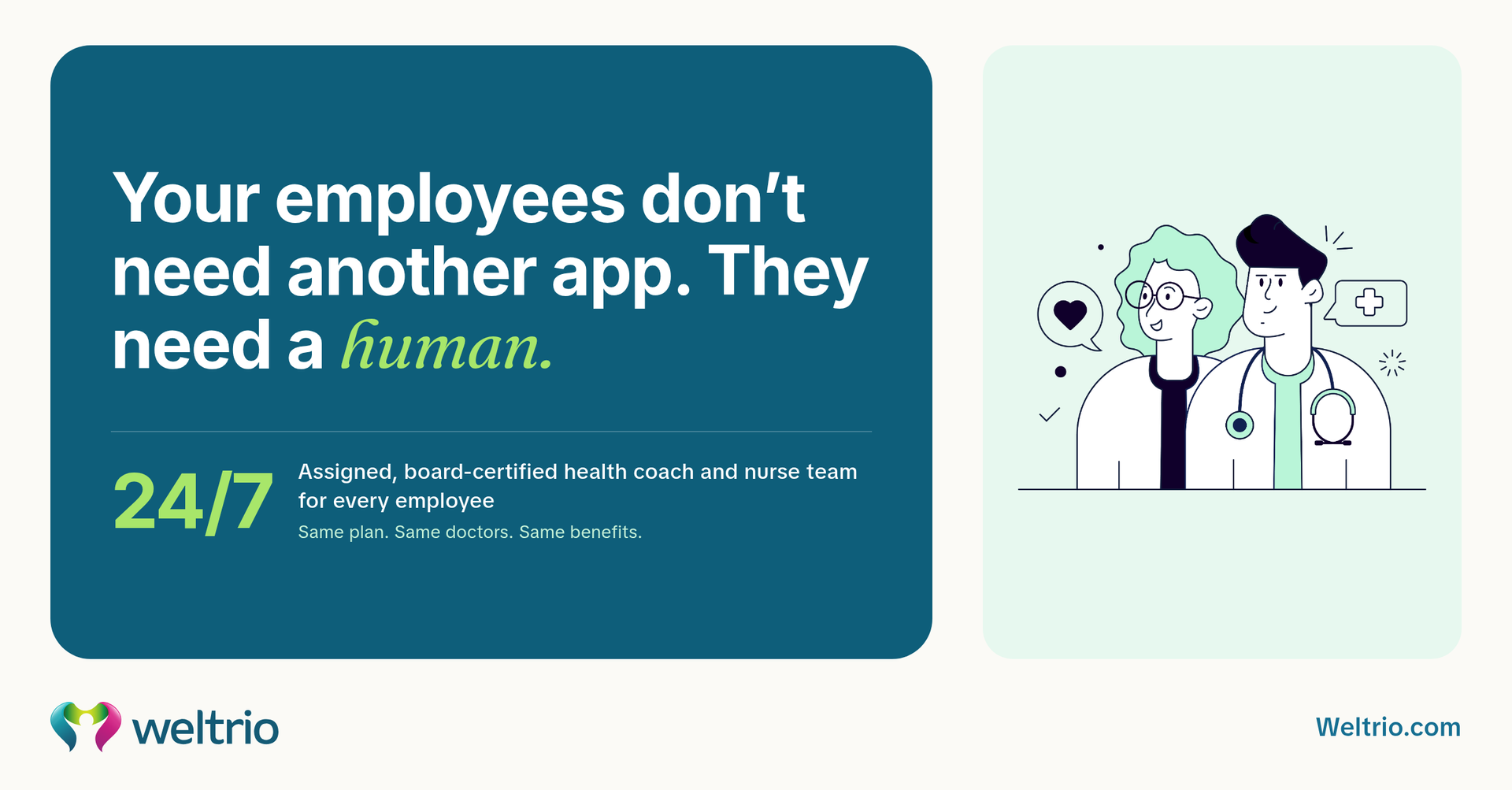
Here's how Weltrio closes them. Every employee gets a 24/7 assigned, board-certified health coach and nurse team. We don't wait for employees to contact us. We reach out first, and that's how Weltrio maintains a 90% proactive engagement rate.
What Should a CFO Ask the Broker Before Signing the Renewal?
Ask your broker what's driving the claims, what the plan does before a claim happens, whether Weltrio can be included in the re-quote, and what the return is net of fee. You don't need to change brokers. Your broker is exactly the right person to bring these questions to, because they already understand your plan design and your renewal history.
Bring these four questions to your next renewal discussion:
- What's driving our claims?
- What does our plan do before a claim happens?
- Can we include Weltrio in the RFQ (request for quote) or re-quote?
- What's the return, net of fee?
That final question matters most to the finance department. Mercer's 2026 survey found that 53% of CFOs are not confident that long-term health benefit cost management strategies that require investment are saving money. Only about one-third are confident. If an investment can't demonstrate a measurable financial return, a CFO is right to question it.
So Weltrio reports results net of our fee. Employers see 15–23% lower healthcare costs, net of fee. Nothing changes for employees: same plan, same doctors, same benefits. Your broker continues managing the plan, and we work alongside them in the pre-claim gap. That makes the renewal conversation more productive for leadership, human resources and the broker.
Get a Clear Read Before You Sign
Your renewal is a budget decision, so give it the same scrutiny as any other significant expense. Ask your broker to include Weltrio in the re-quote. Then let us show you where your plan's pre-claim gaps are.
Prefer a conversation first? Call our team directly at 385-526-7557.
Frequently Asked Questions
Why are 2027 health renewals coming in so high?
Healthcare costs keep running ahead of what employers anticipate. The Business Group on Health found that employers predict a median 9.2% healthcare cost trend increase for 2027, offset to 8% with plan design changes, and actual costs have exceeded employer predictions for three consecutive years.
Can we bring in Weltrio without changing brokers?
Yes. You don't need to change brokers. Ask your broker to include Weltrio in the re-quote, and we'll work alongside them as a partner throughout the renewal and the entire plan year.
Does Weltrio change our plan, network or benefits?
No. Nothing changes for employees: same plan, same doctors, same benefits. Weltrio gives every employee a 24/7 assigned, board-certified health coach and nurse team.
How does Weltrio show its return?
Weltrio reports results net of our fee. Employers see 15–23% lower healthcare costs, net of fee. Your free assessment identifies where your plan's pre-claim gaps are.
About the Author
Kody King is Weltrio's Chief Experience Officer, leading marketing, the assessment process and the client experience, with more than 20 years in user experience design and marketing. He also produces and hosts Behind The Premium, a weekly podcast about the hidden costs in employer health plans.
Sources
- Mercer, "The CFO perspective on health: 2026 survey results," April 2026. https://www.mercer.com/en-us/insights/total-rewards/employee-benefits-strategy/the-cfo-perspective-on-health-2026-survey-results/(full report: https://www.mercer.com/assets/us/en_us/shared-assets/local/attachments/pdf-us-2026-the-cfo-perspective-on-health-report.pdf)
- Alexei Alexis, "CFOs feel healthcare pain rising as GLP-1s stretch budgets: Mercer," CFO Dive, April 22, 2026. https://www.cfodive.com/news/employer-healthcare-costs-rise-9percent-glp1s-stretch-budgets-mercer/818239/
- Business Group on Health, "Cost Volatility Forces Employers To Reassess Healthcare Strategy, Business Group on Health Survey Reveals," August 25, 2026. https://www.businessgrouphealth.org/newsroom/news-and-press-releases/press-releases/2027-employer-healthcare-strategy-survey