Rip Off the Benefits Band-Aid Now, Before It Gets Worse
By Rhonda Nerenberg, Founder & Chief Health Innovation Officer
Waiting on employer health benefit costs feels like the prudent decision, because the 2027 budget is already established and the next renewal can wait a year. But waiting does not hold those costs still. They continue increasing while you wait, and a dollar already spent can't be saved, so starting now is the smaller sting.
Weltrio clients typically see 15–23% lower healthcare costs, net of our fee. You keep the same plan, the same doctors, and the same benefits. Healthcare cost containment, in this setting, begins before a claim exists, at the moment an employee is deciding where and how to obtain care. For finance leaders, that means evaluating the decision against avoidable healthcare spending, rather than treating the fee as an isolated expense.
Here's how I put it: "By the time a claim shows up, the money is already spent and nobody can explain what bought what. We work upstream of that."
Why does waiting on health benefit costs feel safer than it is?
Waiting feels inexpensive because it looks like no decision at all, but it is one. Employers pay about 82% of health plan cost (Aon, 2026), so most of the plan's cost lands on the employer's budget.
What are employer health care costs doing in 2026 and 2027?
Aon reports that employer cost rose 8.8% in 2026, to $14,432 per employee. Looking ahead, U.S. employer health care costs are projected to rise 9.5% in 2027, pushing average costs above $19,000 per employee, before employers make changes ( Aon, Aug 20, 2026). That's a different measure from the $14,432 employer cost. PwC projects group medical cost trend at 9% in 2027, which it calls the highest in 17 years.
Here is what each figure measures. Aon's 8.8% describes employer spending in 2026 after employers made changes, while its 9.5% projection describes average cost in 2027 before employer changes. PwC's 9% is the medical cost trend insurers use to price premiums, assuming benefits stay the same. These figures measure different things and should not be added, blended, or interpreted as one increase.
Aon's figures come from its Health Value Initiative, covering more than 1,100 employers and 7.9 million employees. PwC's projection comes from its Behind the Numbers 2027 study of 27 health plans covering more than 103 million employer-sponsored members. Medical cost trend, as PwC defines it, is the projected rise in the cost to treat patients from one year to the next, assuming benefits stay the same. Insurers use that trend when they price premiums. None of these measures is a forecast of any one company's plan, and they should not be combined to estimate what a year of waiting would cost you.
When you read your renewal as a budget decision, waiting stops looking like a cost-free delay.
Why most of the plan's cost lands on your budget
Aon's plan-cost measure excludes employees' out-of-pocket spending. Keep that distinction in your budget review: employer spending, total plan cost, and medical cost trend describe different parts of the decision, not interchangeable estimates of your company's renewal.
What gets worse each month you wait?
Each month you wait, employees continue making care decisions without guidance, and those claims are submitted and paid. A dollar not spent is 100% of a dollar saved, and a dollar already spent can't be saved. That is also the hardest change before 2028: how people use the plan, not the plan design itself.
Where avoidable spending keeps happening
These are the five areas where our team finds avoidable spending, and where that spending keeps happening while you wait: ER Visits, RX Overpayment, Care Navigation, Late Diagnosis, and Care Logistics. It is not the same as the Care Logistics pillar, which sits with TPAs and PBMs after a claim is filed.
Avoidable ER visits are one clear example. A late-night hospital visit, a higher-cost prescription, or a delayed diagnosis all become paid claims, and once those dollars go out, they do not return to the budget. The longer those five gaps remain open, the more of that spending is already gone.
How 2027 claims shape the 2028 renewal
For larger groups, renewals are typically priced in part on recent claims, so 2027 claims help shape the 2028 renewal ( Society of Actuaries, 2015). While you wait, more of that claims history is written. That makes it harder to change the experience that typically informs the following renewal.
How do you pull off the band-aid without changing your plan?
You keep your current plan, your doctors, and your broker. You don't need to change brokers. Weltrio clients typically see 15–23% lower healthcare costs, net of our fee. Nothing changes for employees: same plan, same doctors, same benefits.
What healthcare cost containment looks like before the claim
Healthcare cost containment means the steps an employer takes to slow the growth of its health benefit spending. Weltrio's approach is one whole approach, not a point solution. It combines care navigation, coaching, Rx sourcing, and 24/7 support from the care team, all aimed at the claims base. Care navigation before the claim is one part of that work, not the whole offer.
A narrow tool addresses a specific problem, but that limited scope leaves other care decisions outside its reach. Weltrio combines its capabilities to guide decisions before claims exist, rather than relying on one service to address every source of avoidable spending.
The work sits in a three-pillar model, always in this order:
- Plan Optimization: owned by your broker, covering plan design and carrier terms, and it changes only at renewal.
- Care Logistics: owned by TPAs and PBMs, and it works after the claim has already been filed.
- Health Advocates: this is Weltrio. We work before the claim, alongside your broker and PBM.
What a 24/7 care team changes for employees
Every employee gets a 24/7 assigned, board-certified health coach and nurse team that reaches out first. Weltrio has a 90% proactive engagement rate, so employees hear from a clinical team they already know and have someone to call before a claim is created. That outreach is how the work happens without a new plan, and without asking employees to give up their doctors.
What one standout client saw
Cayuse Holdings went from $1,600 to $578 per employee per month. That's one standout result, not a typical or expected one.
When is the right time to start, and what's the first step?
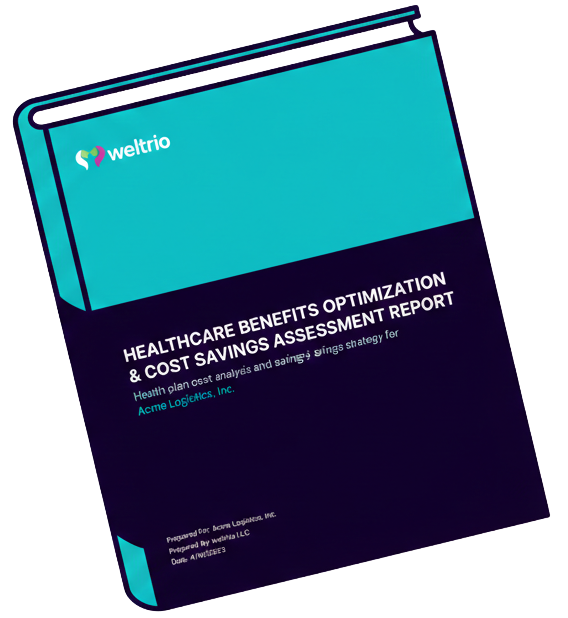
The right time is now, before the first 2027 claims are submitted, and the first step is a free assessment that identifies where pre-claim gaps drive your spending. Waiting until the 2028 renewal letter arrives only leaves another year of paid claims already recorded in the history.
What to do this month
Book the free assessment, begin pre-claim engagement, and include HR and your broker in the conversation about preventable spending. You don't need to change brokers, and nothing has to change for employees. If you want a healthcare partner for CFOs, this is the place to begin.
Schedule your free assessment or call 385-526-7557.
Frequently asked questions
How much will employer health care costs rise in 2027?
Aon projects U.S. employer health care costs will rise 9.5% in 2027, pushing average costs above $19,000 per employee, before employers make changes. Separately, PwC projects group medical cost trend at 9% in 2027, which it calls the highest in 17 years.
Does waiting make my 2028 renewal worse?
Waiting leaves less time to guide care decisions before claims are paid. Start with a free assessment, and bring HR and your broker into the conversation.
Do I need to change my plan or my broker?
No. You don't need to change brokers, and nothing changes for employees: same plan, same doctors, same benefits. Weltrio works alongside your existing broker relationship and your human resources team.
What is healthcare cost containment?
It's what an employer does to slow the growth of its health benefit spending. Weltrio combines care navigation, coaching, Rx sourcing, and 24/7 care-team support before claims exist. Each capability is part of the whole approach, not the entire fix.
How much can an employer save with Weltrio?
Weltrio clients typically see 15–23% lower healthcare costs, net of our fee. A free assessment shows where spending can be avoided.
What's the first step?
Book a free assessment at weltrio.com/meeting or call 385-526-7557. Invite HR and your benefits broker to join.
Sources
- Aon, "Aon: U.S. Employer Health Care Costs Continue Multi-Year Climb, Projected to Rise 9.5% in 2027," press release, Aug 20, 2026. https://aon.mediaroom.com/2026-08-20-Aon-U-S-Employer-Health-Care-Costs-Continue-Multi-Year-Climb,-Projected-to-Rise-9-5-in-2027
- PwC Health Research Institute, "Medical cost trend is expected to hit 9%, highest in 17 years. Can cost management strategies bend the trend?" (Behind the Numbers 2027), Jun 11, 2026. https://www.pwc.com/us/en/industries/health-industries/library/behind-the-numbers.html
- Society of Actuaries, Charles Fuhrer, "A Practical Approach to Assigning Credibility for Group Medical Insurance Pricing," Dec 2015. Report page · PDF
About the author
Rhonda Nerenberg is Weltrio's Founder & Chief Health Innovation Officer.